Overview

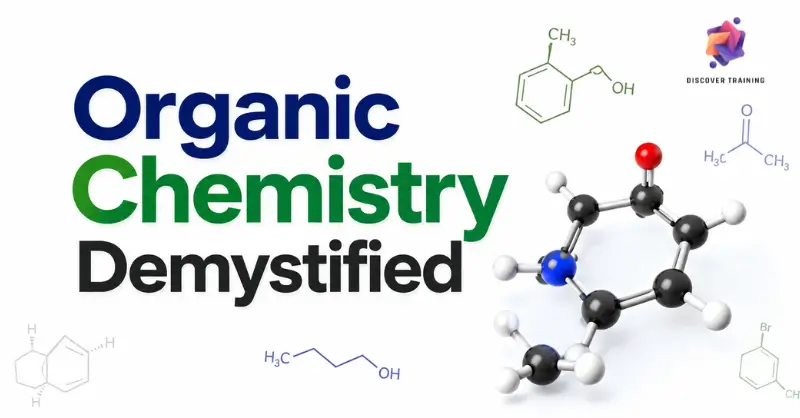
Organic Chemistry Demystified is a structured Organic Chemistry Course UK learners can use to explore carbon-based molecules, molecular representation, resonance, acid–base chemistry, geometry, nomenclature, conformations and stereochemistry. The curriculum then progresses into nucleophiles, electrophiles, reaction mechanisms, substitution, elimination, addition and synthesis techniques. Therefore, this Organic Chemistry Online Course provides a logical route from Organic Chemistry Fundamentals towards more advanced reaction concepts. Through clearly organised Organic Chemistry Lessons, learners can build a useful academic foundation while using Organic Chemistry for Beginners as a starting point for continued study.

Course Description

What if complex molecular structures could become easier to read, name and predict? Organic Chemistry Demystified transforms challenging chemistry concepts into a structured learning journey, beginning with bond-line drawings, formal charges and lone pairs before progressing into resonance and acid–base reactions. As a focused Organic Chemistry Study Course, it introduces orbital geometry, functional groups, unsaturation and systematic nomenclature, helping learners approach carbon compounds with greater clarity.

Next, the curriculum explores Newman projections, chair conformations, stereocentres, enantiomers, diastereomers, meso compounds and Fischer projections. These topics form an important part of Organic Chemistry Fundamentals, while the reaction-focused units introduce nucleophiles, electrophiles, carbocations and arrow-pushing mechanisms. Consequently, learners encounter SN1, SN2, E1 and E2 pathways alongside substitution-versus-elimination decisions and stereochemical outcomes. This makes the programme particularly useful as an Organic Chemistry Revision Course.

Finally, addition reactions cover regiochemistry, stereochemistry, hydrogenation, hydrohalogenation, hydration, halogenation, dihydroxylation and ozonolysis. The closing synthesis section brings reaction sequences together, supporting learners who want to Learn Organic Chemistry in a coherent way. The curriculum reflects the structured progression commonly used in university-level organic chemistry, where molecular structure, stereochemistry, mechanisms and synthesis are closely connected.

Learning Outcomes

Who Is This Course For?

Certification

Once the Organic Chemistry Demystified is successfully completed, the learner can obtain the PDF certificate without any cost. The hard copy of the certificate is also available for £4.99. However, anyone ordering the hard copy certificate from outside the United Kingdom may incur an additional delivery charge.

Career Path

  • Medicinal Chemist – Applies chemical principles to the design, development and optimisation of compounds for pharmaceutical research. With experience, chemist salaries are reported around £43,300–£88,000 per year, with a median of £60,000.
  • Toxicologist – Investigates how chemical substances can affect biological systems and contributes to safety assessment. A current UK salary estimate places the average at approximately £43,247 per year.
  • Chemical Engineer – Develops and improves processes for transforming raw materials into useful products across industrial settings. UK salary information lists experienced earnings up to approximately £65,000 per year.
  • Biochemist – Examines chemical processes within living organisms and applies scientific knowledge across research and related sectors. UK salary information reaches approximately £53,000 per year at experienced level.
  • Clinical Scientist – Applies scientific research and technology to healthcare-related investigation, diagnosis and treatment development. UK career information places typical salaries around £49,000–£65,000 per year.
  • Pharmacist – Uses pharmaceutical science to advise on medicines and their safe supply, subject to the required UK professional qualifications and registration. UK salary information lists approximately £40,000–£65,000 per year.

Schema Markup

Frequently Asked Questions (FAQs)

Organic Chemistry Demystified is a structured programme covering molecular drawings, resonance, acid–base chemistry, nomenclature, stereochemistry, mechanisms, substitution, elimination, addition and synthesis.

Yes. The curriculum is suitable for learners looking for an Organic Chemistry Online Course covering major introductory and intermediate concepts in a structured format.

Yes. The programme begins with foundational molecular representation and gradually progresses towards reaction mechanisms and synthesis, making it suitable for learners beginning their Organic Chemistry for Beginners studies.

The curriculum includes bond-line drawings, resonance, acid–base reactions, orbital geometry, nomenclature, conformations, configurations, mechanisms and several major organic reaction families.

Yes. The sequential structure makes it suitable as an Organic Chemistry Revision Course, particularly for revisiting molecular structures, stereochemistry, mechanisms and reaction outcomes.

Organic Chemistry Demystified Course Reviews

Excellent

4.6 / 5
Based on 3 reviews

98%

Would Recommend

198

Certified Learners

100%

Authentic Reviews

An outstanding online course with clear explanations and practical examples. I could study at my own pace and still feel fully supported throughout. It’s truly boosted my confidence and career prospects

The course was well-structured, engaging, and easy to follow. The flexibility made it perfect alongside my full-time job. I’ve gained valuable, real-world skills that I can apply immediately.

Excellent learning experience from start to finish. The content was professional, up-to-date, and highly relevant. I would highly recommend it to anyone looking to upskill online.

Course Curriculum

Unit 01: About the Course
Introduction 00:02:00
Unit 02: Drawing Organic Molecules
How to read bond-line drawings 00:18:00
How to draw bond-line drawings 00:18:00
Identifying formal charges 00:22:00
Finding lone pairs that are not drawn 00:23:00
Unit 03: Resonance
What is resonance? 00:05:00
Drawing resonance structures (part 1) 00:40:00
Formal charges in resonance structures 00:19:00
Drawing resonance structures (part 2) 00:25:00
Recognizing patterns 00:30:00
The relative importance of resonance structures 00:19:00
Unit 04: Acid-Base Reactions
Introduction to acid – base 00:03:00
Charged atoms 00:08:00
Resonance 00:11:00
Induction 00:09:00
Orbitals 00:03:00
Charged atoms – Resonance – Induction – Orbitals 00:07:00
Showing an acid-base mechanism 00:14:00
Acid-Base equilibrium position 00:06:00
Unit 05: Geometry
Orbitals 00:15:00
Goemetry of orbitals 00:15:00
Impact of resonance on geometry 00:01:00
Unit 06: Nomenclature
Introduction to nomenclature 00:03:00
Functional group 00:07:00
Unsaturation 00:04:00
Parent 00:09:00
Substituents 00:10:00
“cis” – “trans” stereoisomerism 00:04:00
“E” – “Z” stereoisomerism 00:04:00
Localizing substituents in parent chain 00:12:00
From structure to name 00:20:00
Unit 07: Conformations
Introduction to conformations 00:02:00
Newman projection 00:10:00
Relative stability of Newman projections 00:08:00
Drawing chair conformations 00:02:00
Drawing substituents in chair conformations 00:12:00
Ring flipping 00:10:00
Comparing stability of chair conformations 00:10:00
Unit 08: Configurations
Introduction to configurations 00:01:00
Locating stereocenters 00:04:00
Determining the configuration of a stereocenter 00:18:00
Nomenclature 00:12:00
Enantiomers 00:08:00
Diastereomers 00:05:00
Meso compounds 00:04:00
Fischer projections 00:11:00
Unit 09: Mechanisms
Introduction to mechanisms 00:02:00
Nucleophiles and electrophiles 00:09:00
Arrows used for mechanisms 00:14:00
Carbocation 00:15:00
Unit 10: Substitution Reactions
SN1 SN2 mechanisms 00:10:00
Factor #1: the electrophile 00:06:00
Factor #2: the nucleophile 00:04:00
Factor #3: the leaving group 00:05:00
Factor #4: the solvent 00:05:00
Combining all 4 factors 00:10:00
Unit 11: Elimination Reactions
Introduction to elimination reactions 00:02:00
E1 mechanism 00:08:00
E2 mechanism 00:20:00
Unit 12: Substitution vs Elimination
Introduction to substitution vs elimination 00:03:00
Determining the function of the reagent 00:04:00
Identifying the mechanism(s) 00:11:00
Predicting regiochemical and stereochemical outcomes 00:16:00
Unit 13: Addition Reactions
Introduction to addition reactions 00:01:00
Regiochemistry 00:05:00
Stereochemistry 00:18:00
Hydrogenation: adding H-H 00:07:00
Hydrohalogenation: adding hydrogen halide, H-X 00:09:00
Hydrobromination : adding H-Br 00:09:00
Hydration: adding H-OH 00:12:00
Adding Br and Br 00:05:00
Halohydrin formation: adding Br and OH 00:08:00
“Anti” dihydroxylation: adding OH and OH 00:07:00
“syn” dihydroxylation : adding OH and OH 00:04:00
Ozonolysis 00:03:00
Reactions summary 00:01:00
Unit 14: Synthesis Techniques
One-step synthesis 00:03:00
Combining reactions: changing the position of a leaving group 00:03:00
Combining reactions: changing the position of a double bond 00:02:00
Combining reactions: introducing functionality 00:03:00
Unit 15: Wrapping Up and Bonus
Thank you for enrolling and announcing part 2 00:01:00

Frequently Asked Questions

Yes, Discover Training provides accredited and CPD-certified courses, ensuring learners receive recognised qualifications that support career progression and professional compliance.

Anyone can enrol, including students, professionals, job seekers, career changers, and organisations. Most courses do not require previous experience, making them accessible to learners at all levels.

Discover Training offers courses across multiple sectors, including business, health and safety, compliance, leadership, IT, personal development, and professional skills training.

You will have 14 days to revoke your Course purchase from your purchase date. Regrettably, refunds are not allowed after your purchase have been approved, and materials have been posted to the student’s dashboard or accessed.

Yes, learners receive a downloadable digital certificate upon successful completion, suitable for CPD records, CVs, and professional portfolios.

Organic Chemistry Demystified
£21
TAKE THIS COURSE

14-Day Money-Back Guarantee

This course includes:
  • units Number of Units:
    81
  • Lock Access:
    1 Year
  • Duration Duration:
    12 hours, 28 minutes
  • Certificate PDF Certificate
    Included
CPD and SSL Lifetime Access

Discover Training provides high-quality online courses covering a variety of topics along with certificates issued by top organisations.

Certificate Validator​

Copyright © 2026 Discover Training, trading under GTECHNICS LTD (Company number 14290557)

Company registered in England and Wales. ALL RIGHTS RESERVED.

top