Learn automatic number plate recognition in Python with deep learning, OCR, Flask, dataset preparation and web application development.
( 29 Reviews )
210 Students
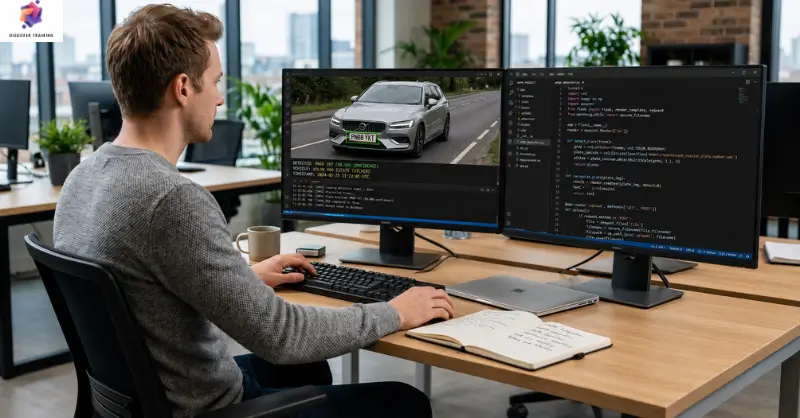
Automatic number plate recognition in Python is a computer vision approach that detects vehicle registration plates and converts their characters into digital information. This course presents a complete development pathway covering project architecture, dataset collection, annotation, labelling, preprocessing, model training and evaluation. Furthermore, learners explore Tesseract, Pytesseract and OCR integration before connecting the recognition system to a Flask-based web application. Through this structured curriculum, the programme combines computer vision with Python, deep learning and web technologies to demonstrate how an intelligent number plate solution can be developed from data preparation through to application output.
Turn vehicle images into meaningful registration data by developing an intelligent recognition workflow with Python. This course introduces learners to an ANPR Python course pathway, beginning with project architecture, data collection, annotation requirements, labelling, XML-to-CSV conversion and verification. Subsequently, learners explore preprocessing and train-test dataset separation before progressing into an OpenCV ANPR project. The curriculum then moves towards model construction, training, retraining, saving and TensorBoard monitoring, providing a structured route for creating a number plate recognition system.
Next, learners test the trained model, work with denormalisation and bounding, and create a complete processing pipeline. In addition, the programme introduces Tesseract and Pytesseract for Python OCR development, enabling registration characters to be extracted from detected plates. This creates a practical connection between detection, image processing and automatic number plate recognition technology.
Finally, the course brings these components together through Python web application development. Learners work with VS Code, Flask, templates, Bootstrap, navigation, uploads and deep-learning integration to create an OCR web app in Python. Moreover, the programme introduces concepts associated with an optical character recognition course and explores how licence plate recognition software can connect intelligent models with a browser-based interface.
Once the Automatic Number Plate Recognition, OCR Web App in Python is successfully completed, the learner can obtain the PDF certificate without any cost. The hard copy of the certificate is also available for £4.99. However, anyone ordering the hard copy certificate from outside the United Kingdom may incur an additional delivery charge.
Machine Learning Engineer
Develop machine learning models, prepare datasets and create intelligent systems for image recognition, classification and automated data processing.
Average Salary: £45,000 – £75,000 per year
Computer Vision Engineer
Design computer vision solutions that analyse images and video while applying detection, image processing and machine learning technologies.
Average Salary: £45,000 – £80,000 per year
Python Developer
Build software applications, automation solutions and web platforms using Python frameworks, APIs and supporting development technologies.
Average Salary: £40,000 – £65,000 per year
AI Software Engineer
Integrate artificial intelligence models into software applications, develop intelligent features and support machine learning implementation.
Average Salary: £50,000 – £85,000 per year
Computer Vision Software Developer
Create applications that process visual information using computer vision, OCR, and machine learning techniques for specialised technology solutions.
Average Salary: £45,000 – £75,000 per year
OCR Developer
Develop optical character recognition solutions that convert text from images into machine-readable information using OCR engines and programming technologies.
Average Salary: £40,000 – £70,000 per year
Automatic number plate recognition in Python uses image processing, computer vision, and OCR technologies to identify vehicle registration plates and convert visible characters into digital text. It can form the basis of intelligent vehicle-monitoring applications.
A number plate recognition system can be developed by collecting suitable images, preparing annotations, preprocessing datasets, training a detection model, and applying OCR to recognised registration areas. This course follows these stages within one structured project.
Python OCR development commonly involves tools such as Tesseract and Pytesseract for converting characters within images into machine-readable text. The course explores OCR integration after plate detection, helping connect recognition output with the wider application workflow.
An OCR web app in Python is a browser-based application that can receive an uploaded image, process visual information, and return extracted text. This course combines Flask, templates, Bootstrap, uploads and deep-learning integration to create an application-based OCR workflow.
Yes. Python can support automatic number plate recognition through computer vision, deep learning, and OCR libraries. A complete solution may combine dataset preparation, model training, plate detection, Tesseract or Pytesseract, and Python web application development.
An outstanding online course with clear explanations and practical examples. I could study at my own pace and still feel fully supported throughout. It’s truly boosted my confidence and career prospects
The course was well-structured, engaging, and easy to follow. The flexibility made it perfect alongside my full-time job. I’ve gained valuable, real-world skills that I can apply immediately.
Excellent learning experience from start to finish. The content was professional, up-to-date, and highly relevant. I would highly recommend it to anyone looking to upskill online.
| Module 01: What we will do | |||
| Project Architecture | 00:03:00 | ||
| Module 02: Date and Labeling | |||
| Get the data | 00:01:00 | ||
| Download annotation | 00:02:00 | ||
| Requirements annotation | 00:03:00 | ||
| Labeling | 00:02:00 | ||
| XML to CSV | 00:10:00 | ||
| Read data | 00:08:00 | ||
| Verify data | 00:06:00 | ||
| Module 03: Preprocessing | |||
| Data preprocessing | 00:10:00 | ||
| Split data into train test | 00:03:00 | ||
| Module 04: Train Object Detection Model | |||
| Model building part 1 | 00:03:00 | ||
| Model building part 2 | 00:06:00 | ||
| Model building part 3 | 00:02:00 | ||
| Model building part 4 | 00:02:00 | ||
| Model Training new | 00:04:00 | ||
| Train again | 00:02:00 | ||
| Save model | 00:03:00 | ||
| Tensorboard | 00:04:00 | ||
| Module 05: Pipeline | |||
| Test model | 00:10:00 | ||
| Test model part 2 | 00:04:00 | ||
| Denormalize | 00:04:00 | ||
| Bounding | 00:05:00 | ||
| Make Pipeline | 00:05:00 | ||
| Module 06: OCR | |||
| Install tesseract OCR | 00:05:00 | ||
| Install pytesseract | 00:02:00 | ||
| OCR numberplate | 00:06:00 | ||
| Module 07: 7 Number Plate Web App | |||
| Install VS code | 00:04:00 | ||
| First flask | 00:07:00 | ||
| Render template | 00:07:00 | ||
| Boostrap | 00:03:00 | ||
| Navbar | 00:03:00 | ||
| Footer | 00:02:00 | ||
| Template inheritance | 00:03:00 | ||
| Upload | 00:04:00 | ||
| Integrate deeplearning | 00:13:00 | ||
| Integrate | 00:06:00 | ||
| Get output part 1 | 00:08:00 | ||
| Get output part 2 | 00:07:00 | ||
| Assignment | |||
| Assignment – Automatic Number Plate Recognition, OCR Web App in Python | 00:00:00 | ||
Yes, Discover Training provides accredited and CPD-certified courses, ensuring learners receive recognised qualifications that support career progression and professional compliance.
Anyone can enrol, including students, professionals, job seekers, career changers, and organisations. Most courses do not require previous experience, making them accessible to learners at all levels.
Discover Training offers courses across multiple sectors, including business, health and safety, compliance, leadership, IT, personal development, and professional skills training.
You will have 14 days to revoke your Course purchase from your purchase date. Regrettably, refunds are not allowed after your purchase have been approved, and materials have been posted to the student’s dashboard or accessed.
Yes, learners receive a downloadable digital certificate upon successful completion, suitable for CPD records, CVs, and professional portfolios.
14-Day Money-Back Guarantee