What Is Healthcare Assistant Training?
Healthcare Assistant (HCA) training provides the essential skills and knowledge needed to deliver safe, compassionate care to patients in hospitals, care homes, GP practices, and community settings. This training combines theoretical learning with practical, hands-on experience under the supervision of registered healthcare professionals.
Featured Snippet Definition: Healthcare Assistant training prepares individuals for entry-level medical roles without requiring prior qualifications. Training includes the Care Certificate (16 standards), clinical skills like vital signs monitoring, personal care techniques, and communication skills. HCAs start on NHS Band 2 (£22,000+) with clear progression to nursing and professional roles.
The training is designed to be accessible, practical, and career-focused—providing immediate employability while opening doors to long-term professional development in the NHS and wider healthcare sector.
Why HCA Training Is the Perfect Medical Career Entry
The Accessible Gateway
Unlike most medical careers that require years of university study, HCA training has no formal entry requirements. You don’t need A-levels, a degree, or prior healthcare experience to start. This makes it an ideal entry point for:
– School leavers exploring healthcare careers
– Career changers seeking meaningful work
– Parents returning to employment
– Individuals from non-healthcare backgrounds
Immediate Employment
HCA training leads directly to paid employment. While training for other medical roles often requires years of unpaid study, HCA apprenticeships and trainee positions offer earn-while-you-learn opportunities. The NHS actively recruits HCAs with over 700,000 healthcare vacancies nationwide.
The “Grow Your Own” Pipeline
The NHS has identified HCAtoregisteredprofessional pathways as a strategic priority. Health Education England’s Healthcare Support Worker Programme explicitly aims to “grow your own” workforce—recruiting locally, training internally, and progressing staff into registered roles.
This approach benefits both the NHS (reducing recruitment costs and vacancy rates) and individuals (providing structured, supported career development).
No Formal Qualifications Required
Entry Requirements
To start HCA training, employers typically look for :
– Good literacy and numeracy skills
– GCSEs in English and maths (preferred but not always essential)
– A caring, compassionate attitude
– Willingness to learn and work as part of a team
No healthcare qualifications or experience are required. Many successful HCAs come from retail, hospitality, customer service, or completely unrelated sectors.
Alternative Entry Routes
| Route | Requirements | Benefits |
|---|---|---|
| Direct Entry | No formal qualifications required | Start immediately and receive on-the-job training |
| Apprenticeship | No specific qualifications required | Earn while learning with structured progression opportunities |
| Volunteering | No formal entry requirements | Gain hands-on experience and demonstrate commitment |
| Career Changers | Life experience is valued | Maturity and transferable skills are recognised by employers |
Note: Entry routes into health and social care vary by employer, but experience, commitment, and willingness to learn are highly valued.
Clinical Skills and Observations
| Skill | Application | Training Required |
|---|---|---|
| Vital signs | Temperature, pulse, blood pressure, respirations | Care Certificate + workplace assessment |
| Phlebotomy | Taking blood samples | Additional specialist training |
| Cannulation | Inserting IV lines (in some roles) | Competency-based training |
| Catheter care | Emptying bags, hygiene maintenance | Care Certificate Standard 15 |
| Wound dressing | Simple dressing changes | Under nurse supervision |
| Blood glucose | Testing and recording | Competency assessment |
| Peak flow | Respiratory monitoring | Training as required |
The Care Certificate: Your Professional Foundation
Once employed, all HCAs must complete the Care Certificate within 12 weeks. This sets the 16 national standards for knowledge, skills, and behaviours, ensuring consistent, safe care across the NHS.
The certificate covers:
– Understanding your role and personal development
– Duty of care and safeguarding
– Communication and person-centred care
– Basic life support and health and safety
– Infection prevention and control
– Mental health, dementia, and learning disability awareness
Career Progression Pathways
The Three Main Routes to Registered Roles
The Royal College of Nursing identifies three exciting pathways leading to Band 4 or Band 5 registered positions :
1. Nursing Associate (England Only)
– 2year programme leading to a foundation degree
– Band 4 (£25,000£28,000) once qualified and NMC registered
– Learning ‘on the job’ alongside academic studies
– Paid at Band 3 (£24,000£26,000) whilst training
– Option to progress to a shortened nursing degree afterwards
2. Nursing Degree Apprenticeship
– 4year programme leading to a degree and nursing registration
– Band 5 (£28,000£34,000) once qualified
– No tuition fees—paid training position
– Combines work with part-time university study
– Leads to Registered Nurse (RN) status
3. Assistant Practitioner
– 1824 month programme leading to a foundation degree
– Band 4 (£25,000£28,000) once qualified
– Not NMC regulated, but a highly skilled role
– Paid at Band 3 whilst training
– A foundation degree can count toward a shortened nursing degree
Clear Progression Framework
| Stage | Role | NHS Band | Training Route |
|---|---|---|---|
| Entry | Healthcare Assistant | Band 2 | Care Certificate + on-the-job training |
| Intermediate | Senior HCA / Trainee | Band 3 | Level 3 Senior Healthcare Support Worker Apprenticeship |
| Advanced | Nursing Associate | Band 4 | Level 5 Nursing Associate Apprenticeship (2 years) |
| Professional | Registered Nurse | Band 5 | Nursing Degree Apprenticeship (4 years) or traditional degree |
Note: Progression routes in the NHS may vary depending on employer, region, and individual experience. Apprenticeships provide structured pathways into higher clinical roles.
RealWorld Success Stories
From HCA to Registered Nurse
Jess began as a Maternity Support Worker before successfully applying to become a Midwifery Apprentice. She now works as a qualified midwife, having progressed through the structured NHS pathway.
Kelly and Tracy both started as Healthcare Support Workers and are now Macmillan Head and Neck Specialist Nurses—demonstrating that HCA experience provides the foundation for advanced clinical specialisation.
William began caring for elderly people, helping maintain their independence. This experience, combined with his interest in healthy lifestyles, led him to apply for a therapy role. He is now working toward becoming a fully qualified physiotherapist.
Career Changers Welcome
The NHS actively recruits career changers from diverse backgrounds:
– Experienced crew from the airline industry bring customer service and first aid experience
– Retail workers develop communication and organisational skills transferable to healthcare
– Volunteers from community programmes convert to paid HCA roles
The Care Maker pilot at Wrightington, Wigan and Leigh NHS Foundation Trust recruited people with no previous healthcare experience from the local community, converting them into Healthcare Support Workers and feeding the “grow your own” pipeline.
Salary and Benefits: NHS Pay Progression
| Band | Salary Range (2024/25) | Typical Role |
|---|---|---|
| Band 2 | £22,383 – £24,159 | Entry-level Healthcare Assistant (HCA) |
| Band 3 | £24,071 – £25,878 | Senior HCA, Trainee Nursing Associate |
| Band 4 | £25,147 – £27,596 | Nursing Associate, Assistant Practitioner |
| Band 5 | £28,407 – £34,581 | Registered Nurse (progression target) |
| Band 6+ | £35,392+ | Senior roles, specialists, team leaders |
Note: NHS pay scales are updated annually and may vary slightly by region, experience, and additional responsibilities such as unsocial hours or specialist skills.
Skills You’ll Develop
Clinical Competencies
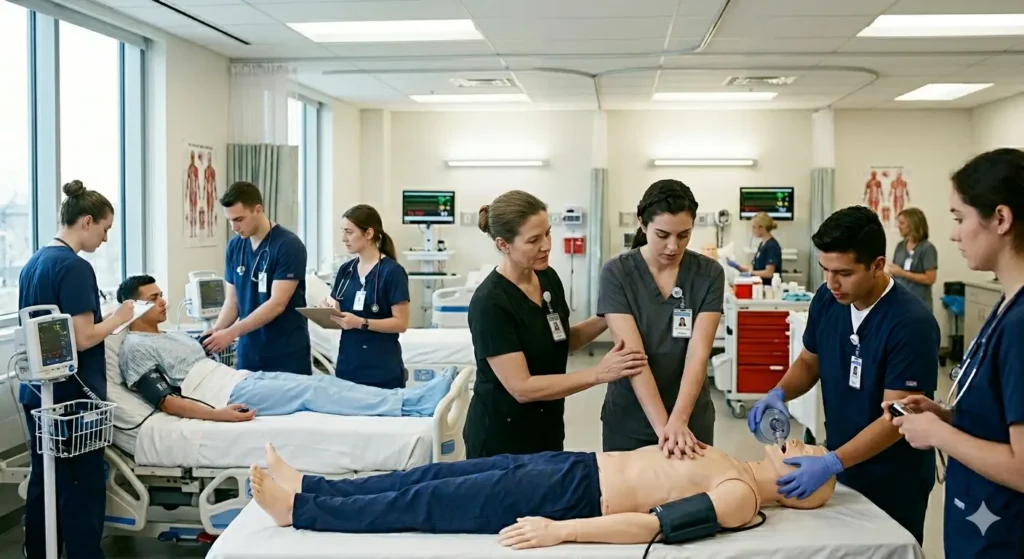
Through HCA training and practice, you’ll develop:
– Vital signs monitoring—temperature, pulse, blood pressure, respirations
– Personal care skills—bathing, dressing, toileting with dignity
– Moving and handling—safe patient transfers and mobility support
– Infection control—hand hygiene, PPE use, environmental cleaning
– Basic life support—CPR and emergency response
Professional Skills
– Communication—with patients, families, and multidisciplinary teams
– Documentation—accurate, timely record keeping
– Teamwork—collaborating with nurses, doctors, and therapists
– Time management—prioritising in fast-paced environments
– Empathy and compassion—providing emotional support
Transferable Capabilities
These skills are valued across healthcare and beyond:
– Customer service excellence
– Problem-solving under pressure
– Organisational and planning abilities
– Cultural competence and diversity awareness
– Professional ethics and boundaries
Common Mistakes and How to Avoid Them
Mistake 1: Underestimating the Physical and Emotional Demands
The Problem: Healthcare work is physically demanding and emotionally intensive. Without self-care, burnout is common.
The Solution: Engage fully with supervision opportunities, maintain work-life balance, and develop resilience strategies from the start. The NHS provides pastoral support for HCSWs.
Mistake 2: Neglecting the Care Certificate
The Problem: Viewing the Care Certificate as a “tickbox exercise” rather than a professional foundation.
The Solution: Take the 12-week programme seriously. The 16 standards provide essential knowledge for safe practice and career progression. Evidence must be gathered through actual workplace observation.
Mistake 3: Rushing Career Progression
The Problem: Pushing for promotion without consolidating foundational skills.
The Solution: Master HCA competencies before advancing. The nursing associate route takes 2 years; nursing degrees take 34 years. Quality patient care requires solid foundations.
Mistake 4: Overlooking Apprenticeship Opportunities
The Problem: Assuming university is the only route to registered roles.
The Solution: Explore apprenticeships seriously. They offer paid training, no tuition fees, and combine work with study. Many trusts have seen retention improve from 49% to 93% with apprenticeship programmes.
Mistake 5: Working in Isolation
The Problem: Attempting to manage difficult situations without team support.
The Solution: Healthcare is team-based. Communicate with nurses, senior staff, and multidisciplinary colleagues. Ask questions and learn from experienced practitioners
Learn with Professional Training
Course Overview
Professional Healthcare Assistant training provides the comprehensive foundation needed for a successful career in the NHS or social care sector. Whether you’re entering healthcare for the first time, changing careers, or seeking to formalise your experience with recognised qualifications, these programmes combine the Care Certificate standards with practical skills development that employers actively seek.
Key Benefits
– Accessible entry: No formal qualifications required to start
– NHS-aligned curriculum: Meets Care Certificate and CQC requirements
– Earnwhileyoulearn: Apprenticeship options available
– Clear progression: Structured pathway from Band 2 to Band 5 and beyond
– Job security: High demand across the healthcare sector
– Meaningful work: Make a tangible difference in patients’ lives
Skills You Will Gain
Upon completion of Healthcare Assistant training, you will be able to:
– Deliver safe, compassionate, person-centred care to diverse patients
– Monitor and record vital signs accurately (temperature, pulse, BP, respirations)
– Assist with personal care tasks sensitively and professionally
– Move and handle patients safely using appropriate equipment
– Maintain infection prevention and control standards
– Communicate effectively with patients, families, and healthcare teams
– Recognise and respond to safeguarding concerns
– Work within NHS values and professional boundaries
– Contribute to multidisciplinary care planning
– Progress to nursing associate, registered nurse, or specialist roles
Career Opportunities
Healthcare Assistant training is your entry point to:
– NHS hospital and community HCA roles
– Care home and residential care positions
– GP practice healthcare support
– Mental health support worker specialisation
– Maternity support worker pathways
– Progression to Nursing Associate (Band 4, £25,000+)
– Registered Nurse (Band 5, £28,000+) through a degree apprenticeship
– Specialisation in theatres, paediatrics, or learning disabilities
– Advanced practice and leadership roles (Band 6+)
Conclusion
Healthcare Assistant training represents one of the most accessible, practical, and rewarding entry points into the medical field. With no formal qualifications required, immediate employment opportunities, and clear progression pathways to registered professional roles, it offers a genuine alternative to traditional university routes.
The NHS’s commitment to “growing your own” workforce means that HCAs are not just entry-level workers—they are future nurses, midwives, and specialists. The structured pathways from Band 2 HCA to Band 4 Nursing Associate to Band 5 Registered Nurse provide a roadmap for career advancement that combines earning with learning.
Whether you’re a school leaver exploring healthcare, a career changer seeking meaningful work, or someone returning to employment, HCA training offers:
– Immediate job security in a high-demand sector
– Paid progression through apprenticeships
– Professional development with recognised qualifications
– Meaningful work making a tangible difference to patients’ lives
The success stories of HCAs who have become specialist nurses, midwives, and therapists demonstrate that this is not just a job—it’s the foundation of a professional medical career. With over 700,000 vacancies and government investment in workforce development, there has never been a better time to enter healthcare through the HCA route.
Start your journey today. Research local NHS trust opportunities, explore apprenticeship options, and take the first step toward a career that offers both professional stability and profound personal fulfilment. Your future in the medical field begins with Healthcare Assistant training.
Frequently Asked Questions (FAQs)
No formal qualifications are required. Employers typically look for good literacy and numeracy, GCSEs in English and maths (preferred but not essential), and a caring attitude. Once employed, you’ll complete the Care Certificate within 12 weeks. Some employers prefer BTEC or NVQ qualifications, but many offer trainee positions with full training provided.
The pathway typically takes 46 years: 12 years as an HCA gaining experience and completing the Care Certificate → 2 years as a Nursing Associate (Band 4) → top-up to registered nurse (Band 5). Alternatively, the Nursing Degree Apprenticeship takes 4 years, directly from HCA to RN. Both routes are paid, with no tuition fees for apprenticeships.
The Care Certificate is a set of 16 national standards for health and social care support workers. It ensures consistent baseline knowledge and skills across the NHS. It covers duty of care, communication, basic life support, infection control, and mental health awareness. It’s essential for safe practice and career progression.
Yes—through the Nursing Degree Apprenticeship. This 4year programme combines work with part-time university study. You’re paid throughout (at least apprentice minimum wage), pay no tuition fees, and qualify as a Registered Nurse (Band 5). Many NHS trusts offer this route specifically for experienced HCAs.
HCAs start on NHS Band 2 (£22,383£24,159). With experience, you can progress to Band 3 (£24,071£25,878) as a Senior HCA. Nursing Associates (Band 4) earn £25,147£27,596, while Registered Nurses (Band 5) start at £28,407. Benefits include a generous pension, 27+ days annual leave, and health service discounts.