

What Is the Difference Between Counselling and Psychology?
Counselling and psychology are distinct but overlapping professions within mental health. While both aim to support people with emotional and psychological difficulties, they differ significantly in training depth, scope of practice, and professional approach.
Featured Snippet Definition: Counselling typically requires a master’s degree and focuses on short- to medium-term talk therapy for specific life challenges. Psychology requires a doctorate (PhD or PsyD), involves psychological testing and diagnosis, and addresses complex mental health conditions. Counsellors cannot diagnose mental illness; psychologists can.
Counsellors primarily address emotional and relationship issues through talk therapy and skills development. They work with clients experiencing grief, relationship difficulties, stress, and life transitions—focusing on current problems rather than deep historical patterns.
Psychologists, particularly clinical and counselling psychologists, work with more complex mental health conditions, conduct psychological assessments, administer diagnostic tests, and often engage in research alongside therapeutic practice.
Why Understanding These Differences Matters
Career Clarity and Planning
Choosing between counselling and psychology affects your educational commitment, career trajectory, and earning potential. Understanding these differences prevents costly mistakes—such as completing a counselling diploma when your goal requires a psychology doctorate.
Professional Scope and Limitations
Each profession has distinct boundaries:
– Counsellors cannot diagnose mental health conditions or conduct formal psychological assessments
– Psychologists can diagnose, test, and treat severe mental illness, but require significantly more training
Client Needs and Appropriateness
Different clients need different professionals. Someone experiencing work stress may benefit from counselling, while someone with complex trauma or personality disorders likely needs a clinical psychologist.
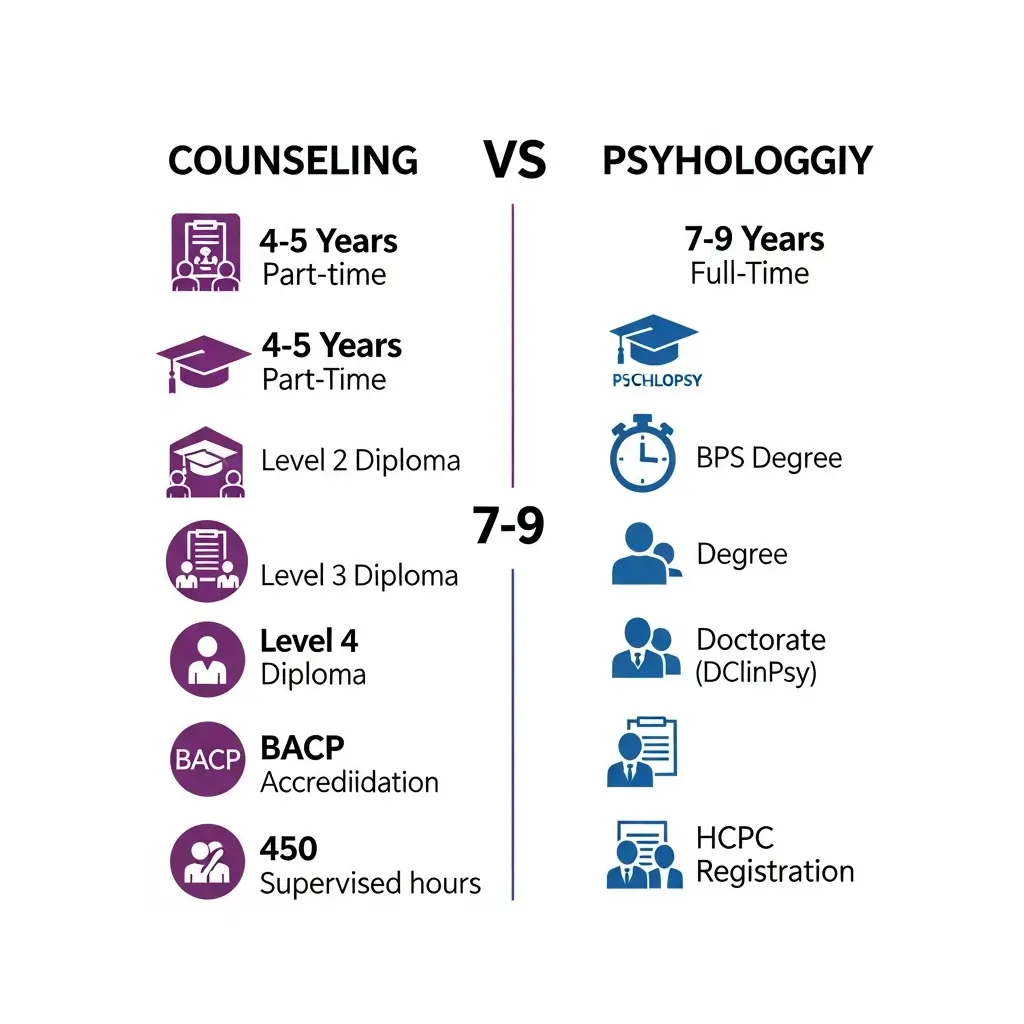
Education and Training Pathways in Counselling
| Stage | Requirement | Duration | Details |
|---|---|---|---|
| Foundation | Level 2 Certificate in Counselling Skills | 1 year | Introduction to listening skills and basic counselling concepts. |
| Intermediate | Level 3 Certificate in Counselling Studies | 1 year | Provides deeper theoretical understanding and practical knowledge. |
| Professional | Level 4 Diploma in Therapeutic Counselling | 2 years | BACP-accredited qualification requiring 100+ client hours and personal therapy. |
| Advanced | Level 5+ or Master's Degree | 1–2 years | Focuses on specialisation, research, and advanced counselling practice. |
Note: Counselling qualifications in the UK often follow a progressive pathway, helping learners build practical skills, ethical understanding, and professional competence step by step.
Psychology Training Route
| Stage | Requirement | Duration | Details |
|---|---|---|---|
| Undergraduate | BPS-accredited Psychology degree | 3 years | Provides a strong foundation in Psychological Science and research methods. |
| Experience | Assistant psychologist or research roles | 1–2 years | Essential experience for competitive doctoral programme applications. |
| Doctorate | DClinPsy or Counselling Psychology doctorate | 3 years | NHS-funded doctoral training focused on advanced clinical practice and assessment. |
| Registration | HCPC registration | Ongoing | Mandatory professional registration required to use the title “Psychologist”. |
Note: The total pathway to becoming a qualified psychologist in the UK usually takes 7–9 years minimum. Unlike counsellors, psychologists require doctoral-level training and HCPC registration for professional practice.
Scope of Practice and Day-to-Day Work
Counselling Practice
Focus Areas:
– Current life challenges and transitions
– Relationship difficulties
– Grief and loss
– Stress and anxiety management
– Self-esteem and personal development
Typical Approach:
– Short-to-medium term (weeks to months)
– Solution-focused and goal-oriented
– Person-centred, CBT, or integrative approaches
– Talk therapy without a formal assessment
Settings:
– Private practice
– Schools and colleges
– GP practices and community health centres
– Employee assistance programmes
– Charities and voluntary organisations
Psychology Practice
Focus Areas:
– Complex mental health conditions (depression, anxiety disorders, personality disorders)
– Neuropsychological assessment
– Diagnostic testing and formulation
– Severe and enduring mental illness
Typical Approach:
– Longer-term therapy (months to years)
– Evidence-based psychological interventions
– Comprehensive assessment and diagnosis
– Integration of research with practice
Settings:
– NHS hospitals and clinics
– Private hospitals
– Forensic settings
– Research and academic institutions
– Specialist assessment centres
Career Outcomes and Specialisations
Counselling Specialisations
– Mental health counselling—anxiety, depression, general wellbeing
– Relationship/couples counselling—marriage and family therapy
– Addiction counselling—substance misuse and behavioural addictions
– Career counselling—vocational guidance and work transitions
– School counselling—supporting students in educational settings
– Bereavement counselling—grief and loss support
Psychology Specialisations
– Clinical psychology—severe mental health conditions, hospital settings
– Counselling psychology—therapeutic practice with assessment
– Forensic psychology—criminal justice and offender behaviour
– Health psychology—physical health conditions and behaviour change
– Educational psychology—learning difficulties and child development
– Neuropsychology—brain injury and cognitive assessment
Career Flexibility
Psychology degrees offer broader career options beyond therapy:
– Human resources and organisational development
– Market research and data analysis
– Forensic and criminal justice roles
– Academic and research positions
Counselling qualifications are more specialised but offer earlier entry into therapeutic work.
Counselling Salaries (UK)
| Experience Level | Typical Salary Range | Notes |
|---|---|---|
| Trainee/Student | £15,000 - £20,000 | Placement work, part-time |
| Newly Qualified | £25,000 - £32,000 | Agency work, NHS Band 5 equivalent |
| Experienced | £35,000 - £45,000 | Private practice, specialisation |
| Senior/Accredited | £45,000 - £60,000+ | Established practice, supervision |
Private practice counsellors may charge approximately £40–£80+ per hour depending on location, expertise, and specialisation.
Psychology Salaries (UK)
| Role | Typical Salary Range | Notes |
|---|---|---|
| Assistant Psychologist | £24,000 - £32,000 | NHS Band 4-5, pre-doctoral |
| Trainee Clinical Psychologist | £35,000 - £40,000 | NHS-funded doctorate |
| Qualified Clinical Psychologist | £47,000 - £55,000 | NHS Band 7 |
| Senior/Consultant | £55,000 - £95,000+ | NHS Band 8a-8c, private practice |
Key Difference: Psychologists typically earn 30–50% more than counsellors due to longer training pathways, doctoral qualifications, and broader clinical responsibilities.
Professional Registration and Accreditation
Counselling Registration (Voluntary but Recommended)
BACP (British Association for Counselling and Psychotherapy):
– Individual accreditation—demonstrates competence and experience
– Senior accreditation—advanced practice aligned to SCoPEd Column C
– Requires ongoing CPD, supervision, and adherence to the Ethical Framework
Other Bodies:
– UKCP (UK Council for Psychotherapy)—for psychotherapists
– NCS (National Counselling Society)—alternative to BACP
Important: “Counsellor” is not a legally protected title in the UK. Anyone can call themselves a counsellor without training. BACP accreditation provides quality assurance.
Psychology Registration (Legally Required)
HCPC (Health and Care Professions Council):
– Legally mandatory to use the “Psychologist” title
– Requires a BPS-accredited doctorate
– Statutory regulation with fitness-to-practise procedures
– CPD requirements for registration renewal
BPS (British Psychological Society):
– Chartered membership for qualified psychologists
– Professional networks and CPD opportunities
– Not legally required but professionally expected
Which Path Is Right for You?
Consider Counselling If:
– You want to enter therapeutic work sooner (4-5 years vs 7-9+)
– You prefer practical, skills-based training over research
– You’re interested in current life challenges rather than complex diagnoses
– You want flexibility to work in diverse settings, including private practice
– You value shorter-term, goal-focused work
Consider Psychology If:
– You’re drawn to assessment, diagnosis, and research
– You want to work with severe and complex mental health conditions
– You’re prepared for 7-9+ years of intensive training
– You want the highest earning potential in mental health
– You’re interested in academic or research careers alongside practice
Key Decision Factors: Counselling vs Psychology
| Factor | Counselling | Psychology |
|---|---|---|
| Time to Qualification | 4–5 years | 7–9+ years |
| Training Cost | £5,000 – £15,000 | Funded (NHS) but highly competitive |
| Research Interest | Low | High |
| Diagnostic Authority | No | Yes |
| Earning Potential | Moderate | Higher |
| Flexibility | High (varied settings) | Moderate (clinical focus) |
Note: Counselling and psychology offer different career pathways, training commitments, and salary expectations. Choosing the right route depends on your interests, career goals, and preferred working environment.
Common Mistakes and How to Avoid Them
Mistake 1: Assuming Counselling and Psychology Are Interchangeable
The Problem: Using these terms synonymously leads to confusion about scope and training requirements.
The Solution: Understand that psychology requires doctoral training and offers diagnostic authority that counselling does not.
Mistake 2: Choosing Based on Salary Alone
The Problem: Pursuing psychology solely for higher earnings without considering the 7-9 year training commitment.
The Solution: Consider whether you enjoy research and assessment, not just therapy. The training is intensive and not suited to everyone.
Mistake 3: Underestimating BACP Accreditation Importance
The Problem: Completing non-accredited counselling courses that don’t lead to professional registration.
The Solution: Ensure your course is BACP-accredited or meets equivalent standards. Check the BACP Approved Qualifications Scheme.
Mistake 4: Thinking a Psychology Degree Makes You a Psychologist
The Problem: Graduating with a BSc Psychology, believing you can practise as a psychologist.
The Solution: A psychology degree is just the foundation. You need a doctorate and HCPC registration to practise as a psychologist.
Mistake 5: Neglecting Personal Therapy During Training
The Problem: Viewing personal therapy as an optional extra rather than essential professional development.
The Solution: Engage fully with personal therapy requirements. This develops self-awareness essential for ethical practice.
Learn with Professional Training
Course Overview
Professional counselling and psychology training provide the qualifications and skills needed for a rewarding career in mental health. Whether you’re drawn to the practical, relational focus of counselling or the scientific, diagnostic depth of psychology, comprehensive training ensures you meet professional standards and can support clients effectively.
Our counselling courses range from introductory Level 2 certificates through to Level 4 diplomas and postgraduate qualifications, all aligned with BACP requirements. For those pursuing psychology, we offer guidance on undergraduate pathways, doctoral applications, and career development.
Key Benefits
– Professional accreditation: Courses designed to meet BACP, BPS, and HCPC requirements
– Practical experience: Supervised client work and placement opportunities
– Flexible study: Part-time options to fit around work and life commitments
– Expert tutors: Learn from experienced practitioners and academics
– Career progression: Clear pathways from entry-level to advanced practice
Skills You Will Gain
Upon completion of counselling or psychology training, you will be able to:
– Apply ethical frameworks and professional standards in practice
– Conduct effective therapeutic relationships with diverse clients
– Use evidence-based interventions appropriate to the client’s needs
– Understand psychological theory and its application to real-world problems
– Engage in reflective practice and continuous professional development
– Navigate professional registration and accreditation processes
Career Opportunities
Counselling qualifications lead to:
– NHS and private practice counselling roles
– School and college counselling positions
– Employee assistance programme work
– Charity and voluntary sector roles
– Specialisation in areas like addiction, bereavement, or relationships
Psychology pathways lead to:
– Clinical or counselling psychologist roles
– Forensic and health psychology careers
– Academic and research positions
– Organisational and occupational psychology
– Educational psychology (with additional training)
Conclusion
Understanding the differences between counselling and psychology is essential for anyone considering a career in mental health. While both professions aim to alleviate suffering and support wellbeing, they differ profoundly in training requirements, scope of practice, and professional identity.
Counselling offers an accessible, practical route into therapeutic work, with shorter training and earlier client contact. It’s ideal for those drawn to relational, talk-based support for life’s challenges. Psychology demands greater educational commitment but offers diagnostic authority, higher earnings, and the ability to work with complex clinical presentations.
Your choice depends on your interests, circumstances, and career goals. Consider whether you prefer practical skills or scientific research, shorter training or maximum professional scope, flexibility or specialisation. Both paths offer rewarding careers making genuine differences in people’s lives.
Whichever route you choose, invest in quality training from accredited providers, engage fully with supervised practice, and commit to ongoing professional development. The mental health field needs skilled, ethical practitioners—whether as counsellors supporting clients through life transitions or psychologists diagnosing and treating complex conditions.
Start your journey today by exploring professional counselling or psychology training that aligns with your aspirations and meets the standards of UK professional bodies.
Frequently Asked Questions (FAQs)
The main difference is training level and scope. Counsellors typically hold diplomas or master’s degrees and focus on talk therapy for current life challenges. Psychologists hold doctorates (PhD/PsyD), can diagnose mental health conditions, conduct psychological testing, and work with complex disorders. Psychologists train for 7-9+ years; counsellors for 4-5 years.
No. To become a registered psychologist in the UK, you need a BPS-accredited psychology degree followed by a doctorate in clinical or counselling psychology. A counselling diploma does not provide the foundation for psychology doctoral training. However, some counselling master’s graduates pursue psychology conversion courses.
BACP accreditation is not legally required but is highly recommended. “Counsellor” is not a protected title in the UK—anyone can use it. BACP accreditation demonstrates you’ve met rigorous training and practice standards, making you more employable and trustworthy to clients. Most NHS and agency roles require BACP or equivalent registration.
Both have strong prospects, but in different ways. Psychology offers higher salaries and status but requires 7-9+ years of competitive training. Counselling offers earlier entry to practice, more flexible career paths, and strong demand (17% job growth projected). Psychology degrees offer broader non-clinical options in business, research, and forensics.
NHS counselling roles typically require a Level 4 Diploma in Therapeutic Counselling (BACP-accredited), BACP individual accreditation or working towards it, and substantial supervised practice hours. Some roles accept UKCP or NCS registration. NHS Band 5-6 counsellors usually need 2+ years post-qualification experience.