

Understanding child psychology in early development has become essential for educators, parents, and childcare professionals across the United Kingdom. With the Early Years Foundation Stage (EYFS) framework placing greater emphasis on holistic development, grasping psychological principles helps create nurturing environments where young children thrive.
Featured Snippet Definition: Child psychology in early development is the scientific study of how children think, feel, and behave from birth through age eight. It examines cognitive, emotional, social, and neurological growth, providing evidence-based frameworks that guide educators and caregivers in supporting optimal developmental outcomes during critical brainbuilding years.
What Is Child Psychology in Early Development?
Child psychology examines the mental, emotional, and behavioural development of children from infancy through adolescence. When focused specifically on early childhood development psychology in the UK, the field concentrates on the formative years from birth to age eight, periods of extraordinary brain plasticity and growth.
This discipline integrates multiple domains:
– Developmental psychology: Tracking milestones and age-appropriate expectations
– Cognitive psychology: Understanding how children process information and solve problems
– Behavioural psychology: Examining how the environment and reinforcement shape actions
– Neuropsychology: Exploring brain structure and function during rapid development
In the UK, the Early Years Foundation Stage child development, these insights translate directly into practice. Ofsted inspections now evaluate settings on how well they apply the psychology of early childhood development to individual children’s needs, making this knowledge professionally essential.
Why Child Psychology Matters in Early Childhood
The importance of child psychology in early childhood development in the UK cannot be overstated. Research consistently demonstrates that experiences during the first five years fundamentally shape lifelong outcomes.
Critical statistics supporting early psychological investment:
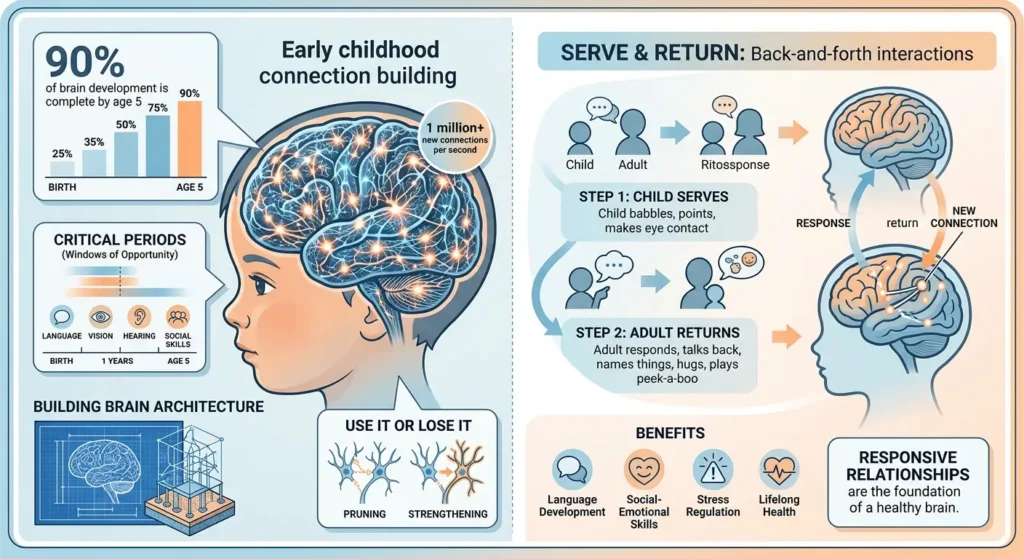
– 90% of brain development occurs before age five, with synaptic connections forming at a rate of 1 million per second during peak periods
– Early intervention for developmental delays proves 34 times more effective than later remediation
– Attachment security in early years predicts academic success, relationship quality, and mental health decades later
– Language acquisition windows close significantly after age seven, making early stimulation crucial
For early years child development, UK professionals, psychological literacy enables:
– Early identification of developmental concerns before they become entrenched
– Differentiated practice that respects individual temperaments and learning styles
– Traumainformed care recognising how adverse childhood experiences (ACEs) impact behaviour
– Optimal challenge provision through understanding the zone of proximal development
The role of psychology in child development extends beyond individual children to systemic improvement. Settings applying psychological principles demonstrate higher Ofsted ratings, better staff retention, and improved parent partnerships.
Key Theories Shaping Early Years Practice
Understanding child development theories provides the foundation for effective early years practice.
| Stage | Age Range | Key Characteristics | Educational Implications |
|---|---|---|---|
| Sensorimotor | 0–2 years | Learning through senses and motor actions; object permanence develops | Provide sensory exploration and cause-and-effect toys |
| Preoperational | 2–7 years | Symbolic thinking emerges; egocentric perspective; intuitive reasoning | Use pretend play, visual aids, and concrete examples |
| Concrete Operational | 7–11 years | Logical thinking about concrete events; understanding of conservation | Use hands-on materials and structured discovery activities |
Theory Focus: Jean Piaget’s cognitive development theory highlights how children's thinking evolves through stages, guiding age-appropriate teaching strategies.
Lev Vygotsky: Social Constructivism
Vygotsky’s work profoundly impacts child psychology and early learning through key concepts:
– Zone of Proximal Development (ZPD): The gap between what children can do independently and what they achieve with skilled support
– Scaffolding: Temporary assistance that helps children master new skills, gradually withdrawn as competence grows
– More Knowledgeable Other (MKO): Anyone with greater expertise—teachers, parents, or capable peers—who facilitates learning
Practical application: Effective psychology-based teaching strategies for preschool teachers involve identifying each child’s ZPD and providing just enough support to stretch without overwhelming.
Erik Erikson: Psychosocial Development
Erikson’s eight-stage theory addresses emotional development in early years:
– Trust vs. Mistrust (01 year): Consistent, responsive caregiving builds fundamental security
– Autonomy vs. Shame (13 years): Supporting independence while maintaining boundaries
– Initiative vs. Guilt (36 years): Encouraging purposeful play and question-asking
These stages directly inform child emotional intelligence development programmes and attachment-focused practice in UK nurseries.
Brain Development in the Early Years
Child brain development in the early years follows predictable yet individualised patterns. Understanding neurobiology helps practitioners create brain-friendly environments.
Key neurological principles:
– Synaptic pruning: Unused neural connections are eliminated while frequently activated pathways strengthen—use it or lose it
– Critical periods: Windows of opportunity where specific skills (language, emotional regulation) develop most readily
– Toxic stress: Prolonged activation of stress response systems without buffering relationships damages developing brain architecture
– Serve and return: Responsive interactions where adults notice and respond to children’s cues build neural foundations
Implications for practice:
– Reduce unnecessary stressors (overstimulation, unpredictable routines)
– Prioritise warm, responsive relationships with key adults
– Provide rich language environments with back-and-forth conversation
– Ensure adequate sleep, nutrition, and physical activity—biological necessities for learning
Cognitive Development: How Young Children Learn
Child psychology and early learning reveal that young children are not passive recipients of knowledge but active constructors of understanding.
Characteristics of early cognition:
– Egocentrism: Difficulty seeing others’ perspectives (peaking around age 4)
– Centration: Focusing on one aspect of a situation while ignoring others
– Irreversibility: Inability to mentally reverse actions
– Transductive reasoning: Connecting unrelated events causally (“I wore red socks, so it rained”)
Effective pedagogical strategies:
– Concrete experiences before abstractions: Let children manipulate physical objects before introducing symbolic representations
– Spaced repetition: Revisit concepts multiple times with increasing complexity
– Elaborative interrogation: Encourage children to explain their thinking (“How do you know?”)
– Interleaving: Mix different types of problems rather than blocking practice
Play-based learning psychology demonstrates that child-directed play builds executive function, creativity, and self-regulation—capacities stronger predictors of later success than early academic skills.
Emotional and Social Development in Early Years
Emotional competence and social development form the foundation for all other learning in early childhood.
| Competency | Description | Developmental Progression |
|---|---|---|
| Emotional Awareness | Recognising own feelings | Labeling basic emotions by age 3; more complex emotions by age 5 |
| Emotional Regulation | Managing emotional responses | Co-regulation with adults → self-soothing strategies → cognitive reappraisal |
| Empathy | Understanding others' feelings | Emotional contagion in infancy → concern by age 2 → perspective-taking by age 4 |
| Social Skills | Navigating peer relationships | Parallel play (2 years) → associative play (3 years) → cooperative play (4+ years) |
Note: Early emotional and social development supports communication, behaviour, and lifelong learning outcomes.
Practical Applications for Early Years Educators
Translating child psychology principles for early years practitioners into daily practice requires intentional planning.
Environment Design
Psychologically-informed spaces feature:
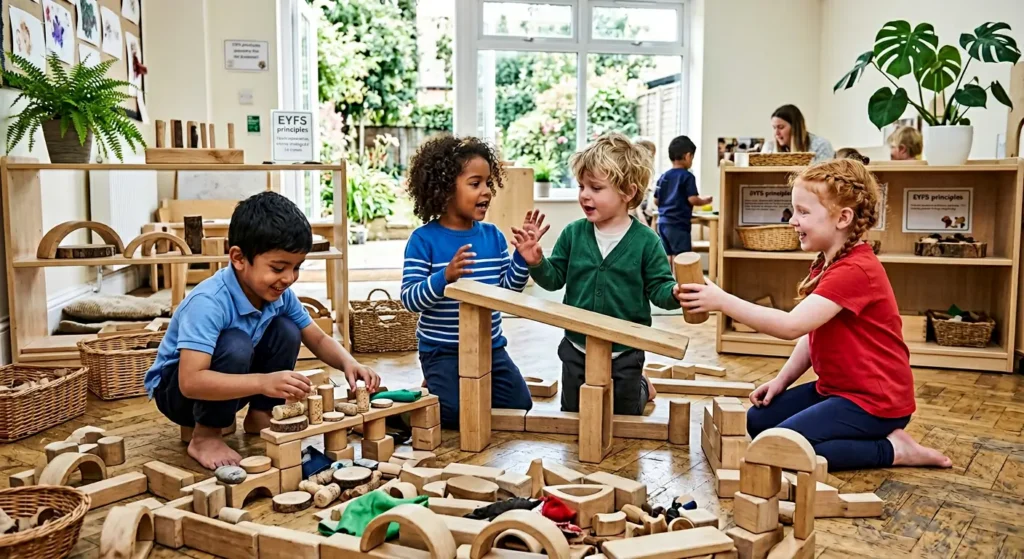
– Defined areas: Clear boundaries between active and quiet zones reduce overstimulation
– Accessibility: Resources at child height promote autonomy and decision-making
– Natural elements: Biophilic design (plants, natural light, wooden materials) reduces stress
– Provocations: Thoughtfully arranged materials that spark curiosity and investigation
Behaviour Management
Child behaviour management strategies grounded in psychology:
– Positive reinforcement: Specific, immediate praise for desired behaviours
– Natural consequences: Allowing children to experience the results of choices (when safe)
– Redirection: Guiding towards acceptable alternatives rather than mere prohibition
– Time in: Staying connected during dysregulation rather than isolation
Observation and Assessment
Psychological observation techniques:
– Running records: Detailed narrative accounts of behaviour in context
– Event sampling: Tracking frequency of specific behaviours
– Anecdotal notes: Brief, dated observations building patterns over time
– Developmental checklists: Milestone tracking against normative expectations
These methods support developmental milestones in early childhood UK monitoring without excessive formal testing.
Common Mistakes and How to Avoid Them
Mistake 1: Developmentally inappropriate expectations
– Problem: Pushing formal academics too early based on parental pressure
– Solution: Advocate for play-based approaches using the psychology of learning in children’s evidence; explain long-term benefits of executive function development
Mistake 2: Misinterpreting challenging behaviour
– Problem: Viewing behaviour as intentional defiance rather than communication of unmet needs or skill deficits
– Solution: Apply functional behaviour analysis—what need is this behaviour meeting? What skills are missing?
Mistake 3: Inconsistent boundaries
– Problem: Alternating between permissive and authoritarian approaches confuses children
– Solution: Authoritative parenting/education style: high warmth combined with high, consistent expectations
Mistake 4: Neglecting educator wellbeing
– Problem: Burnout reduces capacity for responsive, attuned interactions
– Solution: Settings must prioritise staff mental health; coregulation requires regulated adults
Mistake 5: Overlooking individual differences
– Problem: Applying one-size-fits-all approaches, ignoring temperament, culture, and neurodiversity
– Solution: Differentiated practice; understanding that psychological development in preschool children varies enormously within normal ranges
Learn Child Psychology with Professional Training
For early years educators seeking to deepen their expertise, formal child psychology training for nursery staff in the UK provides evidence-based foundations that transform practice.
Course Overview
Our Introduction to Child Psychology for Early Childhood Professionals offers comprehensive coverage of developmental theories, brain science, and practical applications specifically designed for UK early years foundation stage practitioners. The programme aligns with EYFS requirements and Ofsted inspection frameworks.
Key Benefits
– Enhanced practice: Apply psychological principles to daily interactions and environmental design
– Professional recognition: CPD certification valued by employers and inspection regimes
– Career progression: Foundation for advanced study or specialist roles (SEN support, behaviour specialists)
– Parent partnership: Confidence in explaining developmental approaches to families
Skills You Will Gain
– Accurate developmental milestone assessment
– Attachment-informed relationship building
– Emotion coaching techniques for dysregulation
– Play-based learning facilitation
– Early identification of developmental concerns
– Traumainformed practice principles
Certification Value
The Level 3 Certificate carries CACHE endorsement and contributes to CPD requirements for early years registration. Graduates report increased confidence during Ofsted inspections and improved outcomes for children with additional needs.
Career Opportunities
This qualification supports progression to: Early Years Teacher Status, SENCo (Special Educational Needs Coordinator) roles, nursery management, family support work, and further psychology study.
Conclusion
The importance of child psychology in early development extends far beyond academic interest—it represents a practical toolkit for shaping positive life trajectories. For UK early years educators, parents, and childcare professionals, understanding developmental principles, attachment theory, and brain science transforms daily interactions into powerful developmental opportunities.
As our understanding of early childhood psychology evolves through neuroscience and longitudinal research, the evidence increasingly supports relationship-based, play-focused approaches that prioritise emotional security and intrinsic motivation over premature academic pressure.
Whether you’re an experienced practitioner seeking child psychology courses for early years educators in the UK or a parent wanting to understand your child’s world more deeply, investing in psychological literacy yields immeasurable returns. The children in your care are forming 1 million neural connections per second—equipping yourself with evidence-based knowledge ensures those connections build strong, resilient foundations.
Ready to deepen your expertise? Explore accredited child psychology training for nursery staff in UK programmes that translate complex science into practical strategies, and join the movement placing children’s developmental needs at the heart of early years practice.
Frequently Asked Questions (FAQs)
Child psychology provides evidencebased frameworks for understanding how young children think, feel, and learn. This knowledge enables educators to create developmentally appropriate environments, support emotional regulation, identify concerns early, and build the secure relationships that underpin all learning—directly improving outcomes and Ofsted ratings
Psychological experiences shape brain architecture through serveandreturn interactions, attachment relationships, and environmental stimulation. Positive psychologyinformed care builds neural connections supporting cognition, emotional regulation, and social skills, while adverse experiences can disrupt development without intervention.
The EYFS is the statutory framework for children from birth to age five in England, setting standards for learning, development, and care. It emphasises seven areas of learning with the unique child, positive relationships, and enabling environments as core principles—concepts deeply informed by developmental psychology.
Play builds executive function, selfregulation, creativity, and social skills while reducing stress. Through play, children consolidate learning, process emotions, practise social roles, and develop problemsolving abilities—outcomes more predictive of later success than early formal academic instruction.
While psychology matters throughout childhood, the early years (05) represent unparalleled neuroplasticity. Interventions during this window prove most effective, and experiences during these years establish foundational patterns for cognition, emotional regulation, and relationships that persist lifelong.